
April Newsletter

Updated: Apr 11
The Courage to Bloom
April arrives on a quiet breath,
soft as the turning of a hopeful page,
winter loosens its silver grip,
and the earth remembers its color again.
In the hush between rain and sun,
tiny green declarations rise—
blades, buds, trembling leaves—
each one a promise whispered upward.
Clouds gather not in sorrow,
but in generosity,
spilling their silver offerings
onto waiting roots and patient soil.
For every drop that falls
carries a secret:
life is returning.
“April showers bring May flowers,” they say,
but April knows the deeper truth—
that beauty begins in becoming,
in the unseen swelling beneath bark,
in the courage to start again.
Petals are only the visible song;
the real music stirs below,
where seeds split open in the dark
and dare to believe in light.
So too does the world awaken—
not all at once, not perfectly,
but with a steady, stubborn grace.
A longing for gentler days,
for open hands instead of closed fists,
for mornings unshadowed by fear.
April is not just a season—
it is a quiet revolution of hope,
a reminder that even after the coldest silence,
the earth chooses life again.
And perhaps we can too—
rise tender, rise new,
like blossoms after rain,
reaching for warmth,
believing in something brighter
just beyond the clouds.
By Eileen J. Marum
League of Women Voters of the South Coast
Losing SNAP Benefits
People losing access to food assistance programs such as SNAP, school meal programs, and WIC face significant challenges, particularly because many of them are working families, older adults, and people with disabilities living near or below the poverty line. These programs have historically been supported by policymakers across the political spectrum because they address basic needs while helping people maintain stability. When access to these supports declines,
practical and balanced solutions are needed to prevent increased food insecurity and economic hardship.
One important step is strengthening community-based food support systems. Local food banks, community kitchens, and nonprofit organizations can help fill temporary gaps by expanding partnerships with grocery stores, farms, and restaurants to redistribute surplus food. Increasing funding and logistical support for these networks allows them to serve more households efficiently. Communities can also support mobile food distribution programs that reach older adults and people with disabilities who may have transportation barriers.
Another key approach is improving access to employment supports that help working families maintain stable incomes. Expanding job training programs, childcare assistance, and transportation support can help workers increase earnings and maintain consistent employment. For many families near the poverty line, even small increases in wages or work stability can reduce the risk of food insecurity. Employers can also play a role by offering predictable schedules and adequate hours so that workers are better able to budget for food and other necessities.
Policymakers can also focus on adjusting eligibility rules and benefit structures so that individuals do not lose assistance abruptly when their income increases slightly. Gradual phase-outs of benefits allow families to build modest savings without facing sudden losses in support. This approach encourages economic independence while still protecting people during periods of financial vulnerability.
Finally, targeted assistance for older adults and people with disabilities is essential. Expanding home-delivered meal programs, community dining options, and accessible grocery delivery services can help ensure that individuals with mobility or health limitations continue to receive nutritious food. Coordinating these services through local agencies on aging and disability organizations can improve outreach and ensure that those most in need are not overlooked.
Addressing the loss of food assistance requires cooperation among policymakers, community organizations, and employers. By strengthening local food networks, supporting stable employment, designing gradual benefit transitions, and providing targeted services for vulnerable populations, communities can reduce food insecurity while helping people move toward greater economic stability and independence.
Massachusetts House of Representatives Passes the Protect Act
Massachusetts House of Representatives passes the PROTECT Act, March 25, 2026
The Massachusetts House of Representatives has passed the Protect Act, a significant piece of legislation that sets statewide standards for how state and local agencies interact with federal immigration enforcement. The bill aims to bring clarity and consistency to an area that has often been shaped by differing local policies and ongoing legal debate.
Under the PROTECT Act, clear guidelines would govern when and how cooperation with federal immigration authorities takes place. Rather than leaving decisions up to individual cities and towns, the legislation establishes a uniform framework across Massachusetts. Supporters say this approach will help ensure that residents have a consistent understanding of their rights and that public institutions operate under the same set of rules statewide.
A central focus of the bill is limiting the role of local agencies in federal immigration enforcement unless explicitly required by law. Advocates argue that this allows law enforcement and other public systems to remain focused on their primary responsibilities, such as public safety and community services, without becoming involved in complex federal matters.
The legislation also emphasizes the protection of civil liberties. By setting clear standards, the PROTECT Act seeks to reduce the risk of wrongful detention and uphold due process. Supporters believe that well-defined policies can strengthen trust between communities and public institutions, particularly among immigrant populations.
As the PROTECT Act moves forward, it highlights Massachusetts’ ongoing effort to balance public safety, individual rights, and effective governance. Its ultimate impact will depend on how these new standards are implemented and how they shape relationships between state, local, and federal systems.
SUPPORT GUN VIOLENCE PREVENTION MEASURES

Defend An Act Modernizing Firearm Laws: LWVMA will participate in the Vote Yes for a Safe Massachusetts campaign to defeat the Massachusetts Firearm Regulations Referendum (2026).
This is a veto referendum that will be on the November 2026 ballot to repeal An Act Modernizing Firearms Laws; Chapter 135 of MA General Laws. LWVMA supported the passage of this law during the previous legislative session. A YES vote upholds the law as is. A NO vote repeals the law. Learn more and take action via the campaign website. LWVMA is a member of the Massachusetts Coalition to Prevent Gun Violence, a 100+ member organization working to eradicate all forms of gun violence from the Commonwealth. The Coalition is leading the effort to defend An Act Modernizing Firearm Laws. Read more about their efforts below.
Advocate for LWVMA-Supported Bills: In the current legislative session, the League of Women Voters of Massachusetts is supporting two gun violence prevention bills:
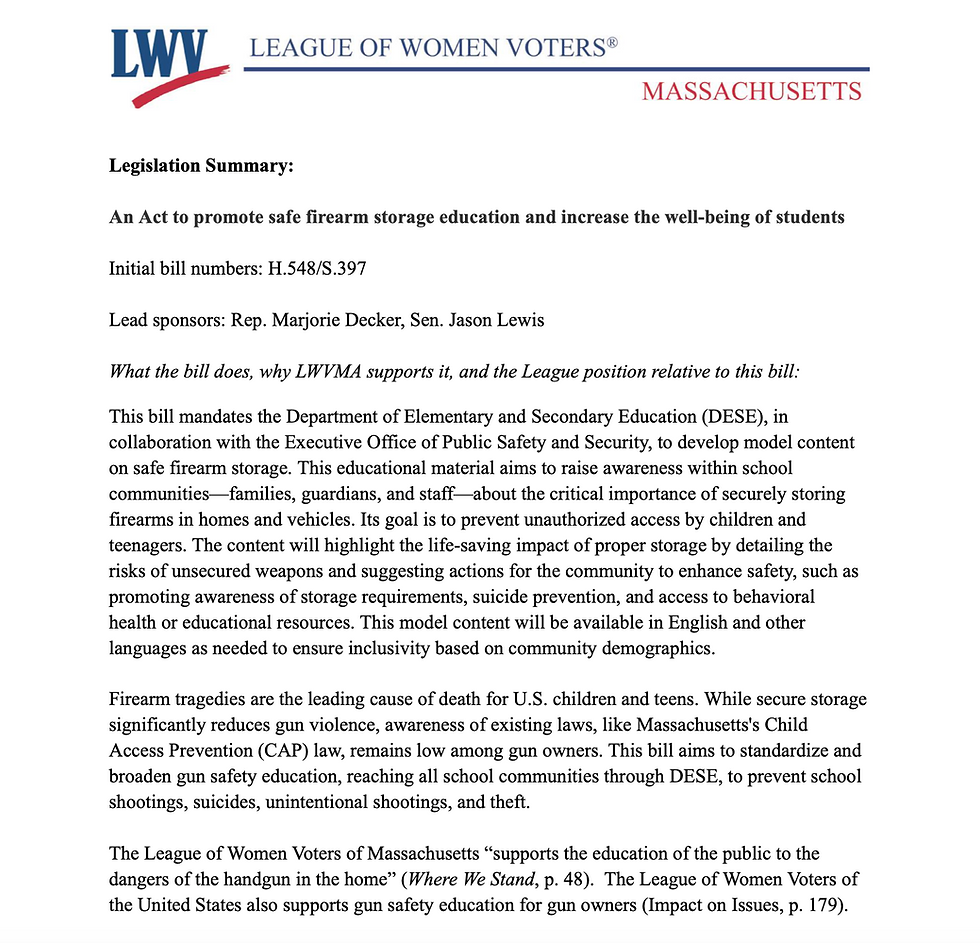
H.548/S.397: An Act to promote safe firearm storage education and increase the well-being of students. Click here to learn more about this bill and why we support it.
H.2672/S.1653: An Act relative to firearm industry accountability and gun violence victims’ access to justice. Click here to learn more about this bill and why we support it.
Please contact your legislators and ask them to support these bills. Thank you for taking action to prevent gun violence and keep our communities safer.
April Meeting
Please join us for our regularly scheduled monthly meeting on April 15, 2026, at 5:30 p.m. at the Millicent Library in Fairhaven. Below is the meeting agenda and March's meeting minutes.

Volunteers urgently Needed
Due to unforeseen circumstances, our membership chair is currently unable to coordinate volunteers. With Candidates’ Night Forums fast approaching, we are asking for your help to ensure LWV SouthCoast has a welcoming and informative presence at these key community events.
These forums are a vital way we connect with the public, encourage civic engagement, and grow our membership. Staffing an information table is a simple but meaningful way to contribute—welcoming attendees, answering basic questions, and sharing what the League stands for.
We are looking for volunteers for the following events:
Mattapoisett — Wednesday, April 22, 2026, 6:30 p.m. to 8:30 p.m.
Old Hammondtown School Cafeteria, 20 Shaw Street
Marion — Thursday, April 23, 2026, 6:30 p.m. to 8:00 p.m.
Sippican School Multi-Purpose Room, 16 Spring Street
Fairhaven — Thursday, May 7, 2026, 6:30 p.m. to 8:30 p.m.
Elizabeth Hastings Middle School, 30 School Street
If you can help at any one (or more) of these events, it would make a real difference. Even a small amount of your time helps ensure we can continue to serve our communities effectively.
Please reply to Eileen J. Marum via Email: u_emarum@umassd.edu or leave a message at Ph: 508-748-1282 if you’re available.
Thank you for stepping up when it matters most—we truly appreciate your support.
LWV SouthCoast Wants to Know
Where do you get your news?
Newspaper
Television
Social Media
Streaming Service
You can vote for more than one answer.
Membership
Thank you to all of our members: new & sustaining.
Did you know that there are tools available to you through the LWV membership portal? There, you can check your membership status, update your profile, access vote411.org, and track your involvement with the league and other organizations you volunteer for. You can even gift a membership or invite someone to join!

From The National League
The SAVE Act
Washington, DC — A coalition of voting rights organizations filed a lawsuit in the US District Court for the District of Columbia to challenge President Trump’s unlawful executive order on voting. The order seeks to seize control of voter
registration rules from Congress and the states.
It would violate federal law and the Constitution if carried out by the Election Assistance Commission (EAC). Key provisions of Trump’s order could disenfranchise millions of eligible voters, particularly voters of color, women voters, naturalized citizens, voters with disabilities, voters with low incomes, and first-time voters.
The Constitution specifies that Congress and the states, not the President, can set the rules for our elections. On March 27, several voting rights organizations sent a letter to the EAC urging them not to take action on key provisions of the executive order, as doing so would violate federal law.
The groups are challenging the order’s usurpation of power, including its directive to the US Election Assistance Commission to change the federal voter registration form to require burdensome documentation to prove citizenship, which many Americans lack or cannot readily obtain. Under existing law, registrants must swear under penalty of perjury that they are citizens, and there is no evidence that non-citizens are registering to vote at significant rates.
“This executive order is a dangerous and unprecedented abuse of power — one that threatens to make it more difficult for American voters, particularly women voters, to participate in our elections,” said Celina Stewart, chief executive officer of the League of Women Voters of the United States. “In the League of Women Voters’ entire 105-year history, we have not witnessed an administration so determined to attack the voting rights of American women this aggressively— but we won’t back down. The League of Women Voters will fight to defend our democracy and to ensure this order is struck down in court. "
"This executive order is an egregious assault on voting rights and the Constitution, and we cannot allow any President to use an illegal executive order to obliterate the rights of millions of voters. The League was founded on the fight for a woman’s right to vote, and we will continue to fight to ensure we protect and maintain this fundamental right for all.”
The president has no constitutional or statutory authority to unilaterally dictate how elections are run. This executive order is a blatant violation of the separation of powers. Congress and the states decide election rules, and any attempt by the executive branch to override their power violates the Constitution. This order, based on a persistent false and racialized narrative, could disenfranchise millions of eligible voters. It mirrors the SAVE Act, which would add unnecessary barriers to voter registration and silence the voices of American citizens. These unlawful attacks on voting rights are part of a broader effort to undermine our democracy. We have filed suit to stop this executive order and to keep it from interfering with eligible voters’ participation in our elections.
HR 22, the Safeguard American Voter Eligibility (SAVE) Act, will require that every eligible voter provide documentary proof of citizenship to register to vote, even though voters in every state are already required to affirm or verify their citizenship status when registering and voting.
Every eligible voter could be unnecessarily burdened by the SAVE Act at some point when they update or change their voter registration information.
Congress must act to ensure that every eligible US citizen has the freedom to vote unimpeded by discriminatory rules rooted in fear and division.
.
The intersection of war policy and financial markets
The intersection of war policy and financial markets is not a recent phenomenon; it is a structural feature of modern economic history. For centuries, governments have relied on financial systems to fund wars, while investors have responded to geopolitical developments that influence national stability, trade routes, and resource supply. What appears novel today is not the existence of this relationship, but rather the speed, scale, and visibility with which geopolitical
decisions now translate into financial gains or losses.
Historically, war and finance have been closely intertwined because large-scale military campaigns require enormous funding. During the Napoleonic Wars, European governments issued massive quantities of bonds to pay for armies and naval fleets. Banking houses, including those run by families such as Nathan Mayer Rothschild, played a central role in distributing this debt and monitoring political developments that could influence repayment prospects. In such an
environment, news of battlefield outcomes or diplomatic treaties could dramatically alter the perceived financial strength of a state. Investors who obtained that information first could adjust their positions in government bonds accordingly.
This dynamic continued into the twentieth century as industrial warfare expanded the scale of military production. The global conflicts of World War I and World War II required unprecedented levels of industrial output and financial mobilization. Governments coordinated closely with private companies to produce weapons, vehicles, and other wartime materials.
Defense spending became a powerful economic force, shaping industries and influencing stock markets. In the United States, the close relationship between government procurement and defense manufacturers later contributed to concerns about the influence of what Dwight D. Eisenhower famously described as the “military-industrial complex.”
Throughout the Cold War, geopolitical tensions continued to drive market behavior. Military buildups, arms races, and regional conflicts affected commodity prices, defense spending, and currency stability. Oil markets, for example, were particularly sensitive to political instability in major producing regions. Investors learned to interpret geopolitical developments as indicators of
future economic conditions.
What distinguishes the present era is the velocity and transparency of the process. Digital communication networks, algorithmic trading systems, and globally integrated markets allow financial reactions to occur almost instantaneously. A statement by a government official, a satellite image of military movement, or a sudden sanctions announcement can trigger large-
scale trading within seconds. At the same time, financial markets are far more interconnected than in earlier centuries, meaning that geopolitical shocks propagate rapidly across equities, commodities, currencies, and derivatives worldwide.
Public visibility has also increased. In earlier eras, information advantages were often confined to elite networks of bankers or diplomats. Today, news of geopolitical developments spreads through global media and social platforms in real time, making the relationship between political decisions and market movements much more visible to the public.
In essence, the underlying structure has remained consistent: war policy shapes economic expectations, and financial markets respond. What has changed is the technological environment in which this interaction occurs. The modern financial system amplifies geopolitical signals with unprecedented speed and scale, transforming political decisions into immediate economic consequences across the global marketplace.
Eileen J. Marum
Chair, League of Women Voters SouthCoast


Comments